About the campaign | IRU | Busworld | Partners | Supporters+downloads | Best practices | Latest News | Calendar | Contact us | 

Buses and coaches for cleaner mobility!


Buses and coaches are the cleanest and most carbon-efficient mode of travel. Let’s not keep this a secret anymore!


Environmental champions


Encouraging people to travel collectively by bus and coach can help reduce our negative impact on the environment considerably. According to the American Union of Concerned Scientists, when travelling by bus or coach, your carbon footprint is the smallest of all transport modes.


UK data shows that coaches emit 0.03 kg of CO2 per passenger-kilometre. This is half that of trains and radically smaller than the amount emitted by cars (0.11) and airplanes (0.18).


Source: OMT Conference on environmentally friendly travelling in Europe, 2006 


A passenger journey from London to Blackpool (385 km) in the UK will emit 11 kg CO2 if done by coach, 23-25 kg if done by train, 44 kg if done by car and 68kg if done by air. If every bus in the UK took just one more car driver as a passenger, up to 1.2 million tonnes of CO2 emissions per year could be saved.


Lowest external costs


External costs (related to noise, accidents, congestion and pollution) of buses and coaches are 26% lower than those of trains.

This includes the externalities resulting from building, maintenance and land coverage of the necessary infrastructure, as well as particulates emitted by roll resistance and breaking.


From 2000 to 2005, thanks to innovation and tremendous industry investment in new technologies, buses and coaches achieved an unprecedented 60% reduction in external costs in Europe, whereas coaches emit the least carbon dioxide per passenger mile when compared to other forms of transportation in the US.


Twenty-five modern buses or coaches built today make no more noise combined than one bus or coach built before 1980.


Working hard to stay on top


Manufacturers and operators are working together to constantly improve the environmental performances of buses and coaches.


In most countries, 10% of the bus and coach fleet is renewed every year using the latest available technology in terms of environment friendliness, safety and comfort. More modern fleets emit a significantly lower amount of pollutants and significantly increase fuel-efficiency, improving air quality and preserving the environment. As an example, over the past three years, USD 971 million has been invested in new buses and coaches in the UK.


In Europe, thanks to the bus and coach industry’s tremendous investment in new technology, noxious emissions such as carbon monoxide, hydrocarbons, nitrogen oxides and particulates, have been reduced by up to 98%!


Noxious Emissions reduction for heavy commercial vehicles (Source: EU Commission, 2008) 


Energy efficient


Buses and coaches built today are remarkably fuel-efficient, especially considering the number of people they carry. To carry one passenger over 100 kilometres, buses and coaches need, on average, between 0.6 and 0.9 litre of diesel fuel whereas, on average, a diesel car will consume 5.9 litres of fuel, a gas-powered car  7.6 litres, an airplane  6.6 litres and high-speed trains 2.6 litres. No other means of collective passenger transport is more energy efficient!


In China, between 2005-2006 oil consumption by the increasingly modern Chinese bus and coach fleet was reduced by 3.6%.


In the US and Canada, the private coach industry provided 206 passenger-miles per gallon (MPG) of fuel in 2007. This is almost three times better than the second most fuel-efficient sector, intercity trains, at 74.1 passenger-MPG. Total transit achieved 55.8 passenger-MPG, air carriers achieved 40.9 passenger-MPG, and automobiles achieved 35.4 passenger-MPG.


According to studies on the energy efficiency (per passenger transported) of different modes of transport commissioned by the French authorities, despite enjoying one of the largest railway network in the world, coaches are 3 times more efficient than private cars, and 2 to 3 times more efficient than trains in regional transport. In interregional transport, coaches are 3 times more efficient than trains, 4 to 5 times more efficient than private cars and 10 times more efficient than airplanes.


It is not only new technologies that offer improved fuel efficiency, and thus fewer emissions, but also the behaviour of drivers. This is why operators are keen to send their drivers on “fuel saving” driving seminars as part of their life-long learning process. Even experienced “old hands” manage to achieve lower fuel consumption after completing one of these courses.


Fighting congestion


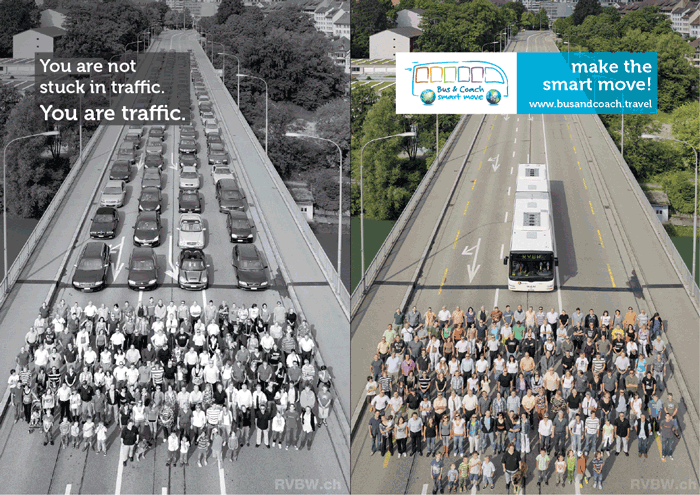
Buses and coaches are an asset in reducing congestion and, as a result, air pollution and road accidents. Average passenger car occupancy rates are falling across the world. In the European Union, in some cases the rate is as low as 1.1-1.2 in short distance commuting. Even for family trips, these range between 1.4 and 1.7.


In Europe, one coach can replace up to 30 cars in terms of average occupancy rates, while one full coach has the potential of removing 55 cars from the road in the US, thus significantly reducing congestion, emissions and cutting energy use of passenger transport by road.


Much more can be achieved if a spirit of partnership prevails between governments, competent authorities, businesses and coach operators in working together to implement pro-coach and bus policies, such as priority lanes and schemes, parking facilities and facilities for drivers, secure parking locations, suitable terminals and stops for scheduled services, etc. These are all essential pre-requisites for any serious anti-congestion policy. In this perspective, the IRU rewards every two years the most coach friendly municipal policies through its IRU City Trophy Award, in a effort to emulate such best practices worldwide.


Buses and coaches are a Green Move!


Find out which policy measures should be implemented to further enhance bus and coach green records.


Print this pageAlphabetical indexSitemapSearch